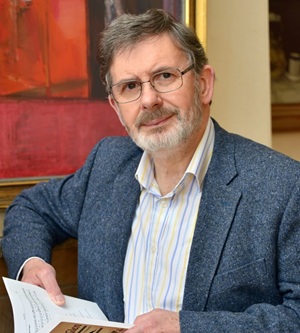
| We were sad to hear of the death of the renowned ethnomusicologist and academic, Prof. Ian Russell on the 16th May 2026, aged 79. While Ian was best known for his endeavours regarding traditional music and song, he also had a brief but significant foray into folk drama research. This obituary will concentrate on Ian's folk play work while also touching on his other interests. |
 |
| Ian's folk drama research was undertaken in the 1970s, when he systematically recorded the then still living tradition of Derby Tup plays - a dramatised song with dialogue found in Northeast Derbyshire and South Yorkshire. Ian did not say in his resulting papers what prompted this project, but as the first plays he recorded were from Unstone and nearby villages, it is possible that he saw a performance near his home. |
The '70s were an interesting and exciting time of British folklore research, and especially for folk drama research, as the new generation of progressive folklorists was sloughing off the Frazerian distraction of supposed ritual origins. They were also changing the way they did field collecting. Previously, they had focussed on collecting the texts and tunes of songs and plays, maybe with a bit of provenance, but with only incidental social context. The new generation was also interested in the circumstances of performance, the family histories of informants, motivations, social interactions, attitudes, etc - things that had hitherto tended to be neglected.
Ian's work, as outlined in his 2006 article on 'Working with tradition', was a fine example of this new approach. In the case of the Derby Tup plays, he was perhaps fortunate that the custom was very much alive and kicking. Starting in 1970, a grant from the EFDSS in 1975 enabled intensive collecting. Ian recorded, photographed, and in some cases filmed accounts from 41 groups (28 in context) from 14 villages. This is an impressive body of work. The resulting article, first presented at the 'Perspectives on Folk Drama 1979', Bretton Hall College, nearly filled a complete issue of Folk Music Journal (of which he was later editor). He also released a video about the tradition.
His Derby Tup article comprised detailed descriptions of the tradition at all 14 villages, with at least one example text and tune from each, along with comparative discussions of costumes, lyrics, dialogue and tunes. These revealed a healthy tradition, but one that was more fluid that earlier armchair scholars might have assumed. For instance, one could not talk of 'the Killamarsh Tup' because Ian encountered multiple versions, each with their own melody, and assembly of lyrics and dialogue elements. Additionally, the versions interacted with each other over time and, unsurprisingly, performances were adapted on the fly for particular audiences.
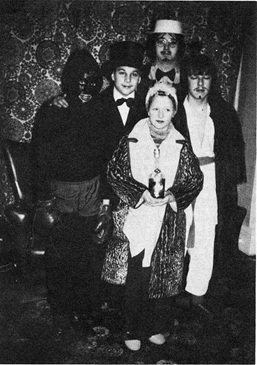 |
Ian's second significant folk play project arose from the first. He was investigating the geographical limits of the Derby Tup tradition in 1977, when he encountered the Flint family of Jacksdale Notts. The family had performed a traditional Bullguisers' hero-combat play, originally from Selston, but in 1975, Keith Flint had decided to rewrite the play in the traditional style, incorporating characters and catchphrases from popular television adverts and programmes. Hence the introduction of the characters 'Brut King', based on a deodorant commercial starring the boxer Mohammed Ali, 'Kung Fluey', inspired by the popular 'Kung Fu' TV series, and 'Slack Alice', lifted from the routines of comedian Larry Grayson. Ian thoroughly documented Keith's rewriting process and how the resulting performances were received. Perhaps inevitably, the novelty of the new version faded after three years, and the family reverted to their traditional text. |
Left: Jacksdale Bullguisers' Brut King play, 1977.
Photo: Ian Russell |
The significance of Ian's Bullguisers article is that it was the first, to my knowledge, in which a scholar had systematically investigated the influence of current events and popular culture on folk play texts. Some earlier scholars had noted a few modern insertions, usually as oddities, and often only as justification for ignoring or excising them collected texts.
Ian was born in Aberdeen, where he spent his infancy, until his family moved to Sandiacre near Nottingham. He was a choral scholar at King's School Ely, where he got a good musical grounding, and attended Nottingham High School for Boys. After gaining a BEd degree at Sheffield City College, Ian embarked on a career as a teacher, first at Unstone, Derbyshire, eventually becoming Headteacher at Anston Greenlands School, South Yorkshire.
In parallel with his day job, Ian pursued his folk interests through fieldwork, mostly in Northeast Derbyshire and South Yorkshire. His research began in the late 1960s, encouraged by the Sandiacre-based folk singer Roy Harris and the Survey of Language and Folklore at the University of Sheffield (later CECTAL and later still NATCECT). His main interests at this time were pub singers in northwest Sheffield and the carol singing tradition of the wider Sheffield area. This eventually led to him gaining his PhD at the Institute of Dialect and Folk Life Studies, University of Leeds. He was a major influence in the continuation and possibly the expansion of the Sheffield Carols tradition, thanks to him convening the biennial Festival of Carols and similar events.
Another enduring interest from this time was the Winster Morris, which he documented and helped to revive, and for whom he played melodeon.
Ian's career and folk interests merged in 1999 when he returned to the city of his birth to take up his dream job as Director of the Elphinstone Institute at the University. Here he turned his attention to the folk music of northeast Scotland, including its traveller community, and convened such events as the North Atlantic Fiddle Convention. He was appointed to a personal chair 2011, becoming emeritus professor on his retirement in 2014. His awards included the Folklore Society's Coote Lake Medal (1986), the EFDSS Gold Badge (1998), and MBE (2020).
It is a testament to the man that despite his move back to Scotland, he continued his active participation in both the Sheffield Carols and the Morris at Winster, where he kept a second home.
Although Ian moved on to other interests, his involvement with folk drama did not end completely. He actively encouraged the Guisers at Winster when Dave Bathe revived their local play. Also, when the James Madison Carpenter project, which included a large collection of folk play texts, lost its base in Sheffield with the closure of NATCECT, he gave them a new home at the Elphinstone Institute.
In conclusion, Ian's work on folk drama has left a permanent legacy to the discipline, as well as to his many other musical interests.
Peter Millington
References
Folk Drama
- Ian Russell (dir.),
Derby Tup,
Garland Films, 1974, 10min
- Ian Russell,
The Old Tup of Derbyshire,
Perspectives on Folk Drama 1979, Bretton Hall College, 7th April 1979.
- Ian Russell,
'Here comes me and our old lass, Short of money and short of brass': A Survey of Traditional Drama in North East Derbyshire 1970-8
Folk Music Journal,
1979, Vol.3, No.5, pp.399-478,
Available at: https://www.jstor.org/stable/4522053, accessed 20th July 2026.
- Ian Russell,
'Appy New Year
English Dance & Song,
Christmas 1981, Vol.43, No.4, p.16.
- Ian Russell,
In Comes I, Brut King: A Discussion of Modernity in Traditional Drama with Reference to Recently Recorded Versions of a Hero-Combat Play from Nottinghamshire,
Traditional Drama 1979,
Sheffield: CECTAL, 1979.
- Ian Russell,
In Comes I, Brut King: Tradition and Modernity in the Drama of the Jacksdale Bullguisers"
Journal of American Folklore,
Oct.1981, Vol.94, No.374, pp.456-485, DOI: https://doi.org/10.2307/540501
Available at: https://www.jstor.org/stable/540501, accessed 20th July 2026.
Sheffield Carols
- Ian Russell,
Carol-Singing in the Sheffield Area
Lore and Language,
August 1970, Vol.1, No.3, pp.12-15,
Available at: https://collections.mun.ca/digital/collection/lorelang/id/62/rec/2, accessed 20th July 2026.
- Ian Russell,
A Survey of a Christmas Singing Tradition in South Yorkshire - 1970
Lore and Language,
January 1973, Vol.1, No.8, pp.13-25,
Available at: https://collections.mun.ca/digital/collection/lorelang/id/103/rec/1, accessed 20th July 2026.
- Derek Schofield,
Ian Russell Obituary,
The Guardian,
31st May 2026,
https://www.theguardian.com/music/2026/may/31/ian-russell-obituary, accessed 20th July 2026
Folk Song
- Ian Russell
Traditional singing in west Sheffield, 1970-2" (3 vols),
PhD thesis, Institute of Dialect and Folklife Studies, University of Leeds, 1977,
Available at: https://etheses.whiterose.ac.uk/id/eprint/21146/, accessed 20th July 2026.
- Ian Russell,
Stability and Change in a Sheffield Singing Tradition
Folk Music Journal,
1987, Vol.5, No.3, pp.317-358,
Available at: https://www.jstor.org/stable/4522241, accessed 20th July 2026.
- Ian Russell,
Working with tradition: towards a partnership model of fieldwork
Folklore,
2006, Vol.117, No.1, pp.15-32. DOI: https://doi.org/10.1080/00155870500479877,
Available at: https://villagecarols.org.uk/articles/working-with-tradition.html, accessed 28th July 2006.
Winster Morris
North Atlantic Fiddle Convention
|